The Nocturnal Bestiary
The Bedroom Presence
No reports collected on this site yet. See the assessment
- Sleep paralysis
- Hypnopompic (waking up)
- Hypnagogic (falling asleep)
The sense that someone is standing in the room, usually in a doorway or beside the bed, reported without any visual detail. It is the most common component of sleep paralysis and one of the most frightening experiences people have.
Also called: someone in my room, sensed presence, the intruder, figure in the doorway
This is an archive of what people report. A consistent description across independent reports is evidence that an experience recurs. It is not evidence that anything external exists. How this archive is built
Where the Old Hag entry covers the crushing form, this one covers the commoner and stranger version: presence without figure.
People report knowing, with total certainty, that someone is standing in the room. They can often say where: the doorway, the foot of the bed, just behind the headboard. They usually cannot say anything else, because there is nothing to see.
That structure is the most reported element of sleep paralysis, and it is a genuinely interesting phenomenon in its own right: a percept-free conviction of another mind nearby.
Editorial assessment
Confidence: sleep-paralysis associated.
The reports are real, consistent and extremely common. The mechanism is well described. This is the intruder factor of sleep-paralysis hallucination, and threat-detection activation without a corresponding percept accounts for the "presence without figure" structure precisely.
What this archive can add, and what it collects reports for: whether the location consistency (doorways, bedside) holds up under careful questioning, and how much of the modern "shadow person" description is naming rather than seeing. The report form's contamination checks exist for exactly this.
Typical appearance
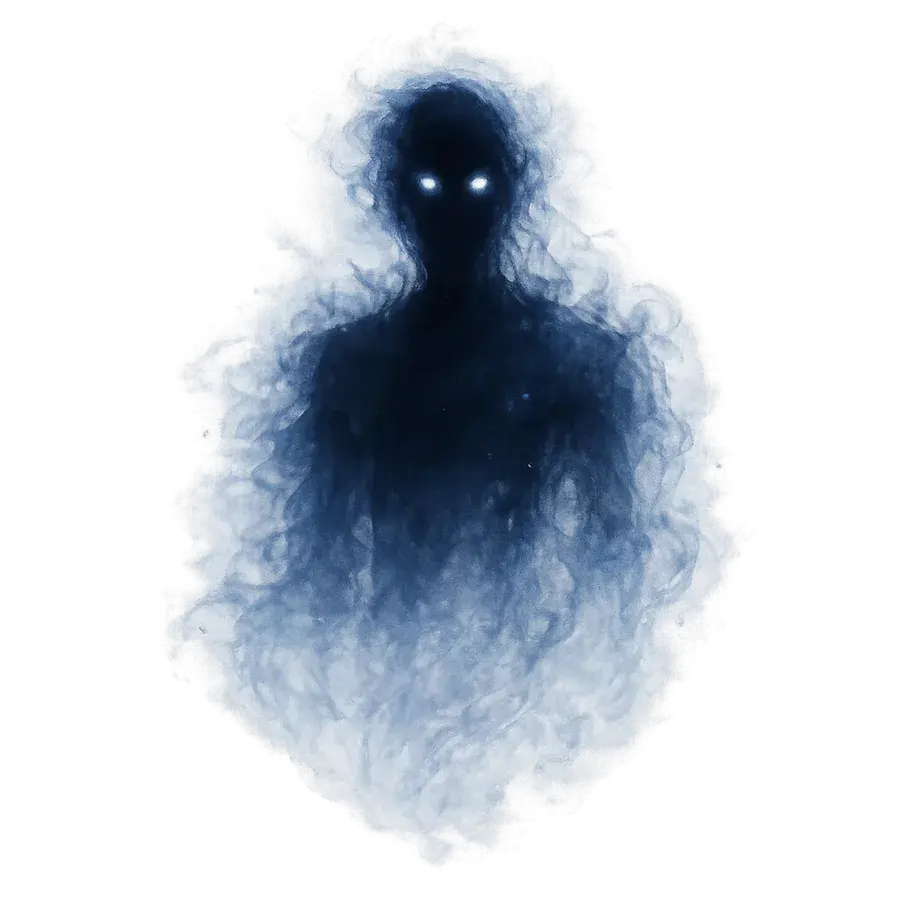
Most reports supply none. Where they do, it is a dark upright shape, a silhouette, or a figure noticed only in peripheral vision.
The location is reported far more consistently than the appearance. Doorways dominate.
Typical behaviour
Stands. Watches. Occasionally approaches slowly. Almost never speaks or acts. The experience characteristically ends before anything happens, which is one of the reasons it is so hard to shake, nothing resolves.
Where it appears
The sleeper's actual bedroom, accurately reproduced, with the sleeper aware of their real position and surroundings.
Common encounter sequence
- Waking or partial waking, often unable to move.
- Sudden certainty of another presence.
- Location identified without seeing anything.
- Rising fear; sometimes a sense of approach.
- Resolution on waking fully, usually within a minute or two.
How the dreamer feels
Dread rather than acute terror, in most reports, a sustained wrongness rather than a shock. Frequently described as certainty of being observed with hostile intent.
Earliest traceable reports
Inseparable from the sleep-paralysis traditions generally. As a distinct "figure in the doorway" report it is heavily represented in modern online accounts, which is a reason for caution about the volume rather than the existence of the reports.
Geographic and community spread
Global. As the intruder component of sleep paralysis it is documented wherever the phenomenon has been studied.
Similarities and differences
The interpretation is where the variation lives: a burglar, a ghost, a dead relative, a demon, a shadow person, an alien. Modern Western reports increasingly describe it as a "shadow person", which is a vocabulary that did not exist before the internet and which should be treated as evidence of naming rather than of a new phenomenon.
Common associations
- The intruder factor in sleep paralysis.
- Presence without percept, the phenomenon proper.
- Threat detection, firing without a target.
- Naming, and how vocabulary reshapes reports.
Positive readings
Recognition helps. People who understand what is happening report markedly less fear in later episodes.
Difficult readings
Sustained dread, and reluctance to sleep. Recurrent episodes track sleep deprivation and irregular schedules closely.
Psychological perspectives
Sensed-presence experiences occur outside sleep as well at altitude, in isolation, during extreme exertion, and in certain neurological presentations. That cross-context occurrence is strong support for a threat-detection account rather than anything external: the same feeling arises whenever the relevant machinery is stressed, regardless of what is actually nearby.
Cultural and historical
See the Old Hag entry. The interpretations vary; the experience does not.
What the sleep science says
The intruder factor is the most commonly reported component of sleep-paralysis hallucination. Sensed-presence experiences are documented across multiple non-sleep contexts, consistent with a threat-detection account.
Your own context
- Could you move?
- Did you ever actually see anything?
- Where was it? Reports are oddly specific.
- Had you encountered the term "shadow person" before this happened?
If this recurs
Track sleeping position, sleep debt and schedule. This is one of the entries where the sleep log is more useful than the dream journal.
Emotions often reported
- dread
- terror
- helplessness
- fear
Questions for reflection
These are for your journal, not for us. Nothing you write is shared.
- Could I move?
- Did I actually see anything, or just know?
- Where in the room was it?
- Did I know the phrase "shadow person" before this?
Dream interpretation is subjective. Nothing here is a diagnosis, a prediction, or medical advice.
Sources and reviewed references
3 references. What these labels mean
- 1.Sleep Paralysis and the Structure of Waking-Nightmare HallucinationsPeer-reviewed research
J. Allan Cheyne (2003) · Dreaming
Cited for: The three-factor structure of sleep-paralysis hallucinations (intruder, incubus and vestibular-motor experiences) which accounts for the recurring "presence in the room" and "pressure on the chest" reports.
- 2.Lifetime Prevalence Rates of Sleep Paralysis: A Systematic ReviewPeer-reviewed research
Brian Sharpless and Jacques Barber (2011) · Sleep Medicine Reviews
Cited for: Prevalence estimates for sleep paralysis across general, student and psychiatric populations.
- 3.The Terror That Comes in the Night: An Experience-Centered Study of Supernatural Assault TraditionsAcademic book
David J. Hufford (1982) · University of Pennsylvania Press
Cited for: The central finding behind this entire archive: that the "old hag" experience shows a stable core description across cultures with no prior exposure to the tradition. That is, the experience generates the folklore rather than the other way round.
Encounters
How the bedroom presence has actually turned up for other dreamers, in their own words. Add a drawing if you have one. A picture describes a figure in a way that the words on this page have not already shaped.
The weight is the part I would want recorded
Everyone describes the figure and nobody describes the chest. For me the presence and the pressure are one thing, not two. It is not that something is in the room and separately I cannot breathe. The pressure is how I know it is there.
That matches the sleep-paralysis literature more closely than the figure-first accounts do. The respiratory muscles stay atonic through REM, so the chest sensation has a mechanism; the presence is the part that is still argued about.
Same here. If I had to drop one half of the description I would keep the weight and lose the figure entirely.
Once, after a very bad flight
I have had this exactly one time, the night after twenty hours of travelling. Something in the room, no shape to it, and about thirty seconds of not being able to move. I would not have thought about it again if I had not found this page. Having read the rest of these I had a go at drawing it, which I want to flag: my picture is probably half everyone else’s descriptions by now. Take it as a drawing of this page as much as of my bedroom.
Only ever when I sleep on my back
Four times now, and every single one on my back after a late night. I have started sleeping on my side deliberately and have not had it since. That is not a claim about what it is. It is just the only variable I have managed to change.
My grandmother called it something else entirely
Marek
In her telling it was a named thing with its own explanation, and she was not remotely frightened of it. It was just a thing that happened to people in that house. I had the same experience at nineteen and it frightened me a great deal, which I think says more about what I had been told than about what was in the room.
Specific encounters
The variants people report most often. Each is written from the accounts rather than composed from this page.
What happened
Where it happened
What state it was in
Related figures
- Dream creatureThe Old HagThe best-evidenced entry in this archive, and the one that founded the method. A crushing presence during sleep paralysis, reported with a consistent core description across cultures that had no contact with each other.Widely reported
- Dream creatureThe Shadow PersonA dark humanoid figure, featureless, often seen at the edge of vision. The underlying experience is well documented; the name, the appearance and the shared details are substantially a product of the internet, and this page treats them separately.Internet-influenced
- ActionBeing watchedThe sense of being watched is one of the most consistently reported dream experiences and one of the hardest to describe, because the watcher is usually never seen. In sleep paralysis it has a specific, well-documented physiological basis.
- Dream creatureThe Hat ManA tall dark figure in a brimmed hat, reported during sleep paralysis. The most famous entry in modern dream-entity folklore, and one where the evidence for independence is weaker than its reputation suggests.Internet-influenced
- Dream creatureThe WatcherA presence at the edge of a dream landscape (treeline, doorway, horizon) that watches and does not approach. Distinct from the bedroom presence in that it occurs inside dream narratives rather than at the sleep boundary.Emerging pattern
- Dream creatureThe Black DogA famous folkloric figure with a very thin dream record. Included, and marked insufficient, as a worked example of an entry that does not meet this archive's standard.Insufficiently verified