The Nocturnal Bestiary
The Watcher
No reports collected on this site yet. See the assessment
- Ordinary dream
- Nightmare
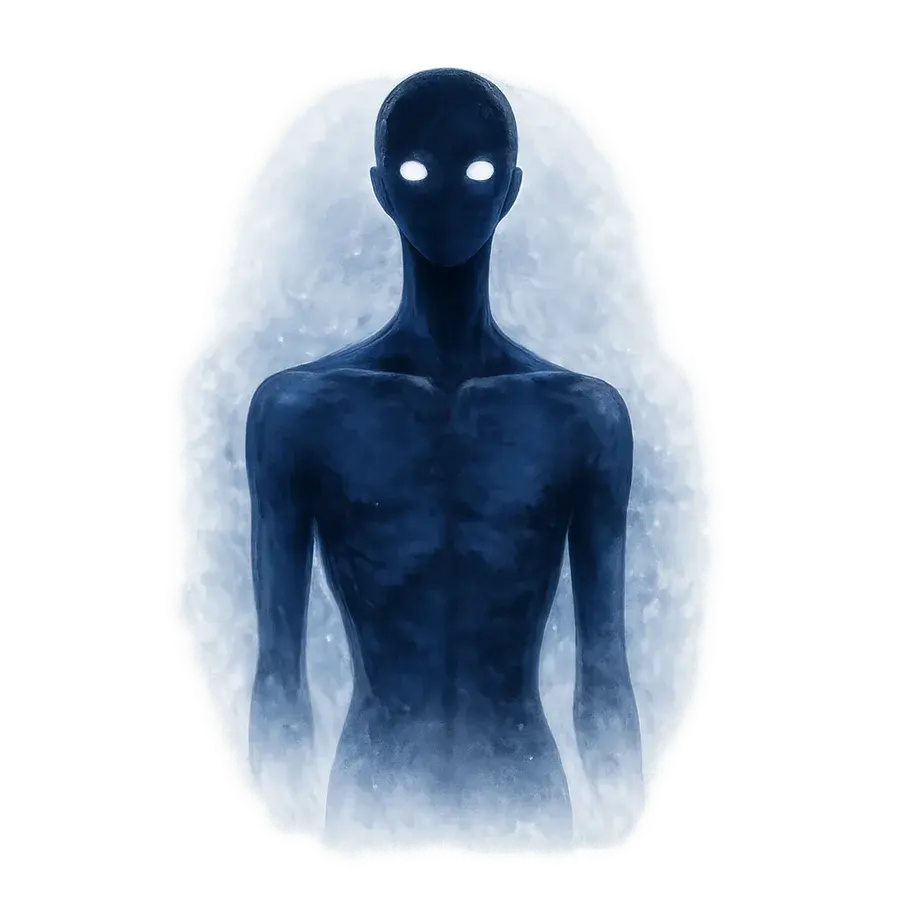
A presence at the edge of a dream landscape (treeline, doorway, horizon) that watches and does not approach. Distinct from the bedroom presence in that it occurs inside dream narratives rather than at the sleep boundary.
Also called: the watcher, something watching, eyes in the dark, presence at the edge
This is an archive of what people report. A consistent description across independent reports is evidence that an experience recurs. It is not evidence that anything external exists. How this archive is built
This entry separates something that is usually merged into the sleep-paralysis material, and the separation is the point.
The bedroom presence occurs at the sleep-wake boundary, in the sleeper's real room, usually with paralysis. The Watcher occurs inside an ordinary dream narrative, in a dream landscape, with the dreamer moving and acting normally. It watches from a distance, at an edge (a treeline, a ridge, the far end of something) and it does not approach.
Whether these are the same phenomenon in two states or two different things is genuinely open, and it is the kind of question this archive exists to ask. The report form's dream-state field is what would eventually answer it.
Editorial assessment
Confidence: emerging.
A small number of independent but notable reports sharing an unusual structural feature: observation from a boundary, without approach.
The honest position is that this may simply be the sensed-presence phenomenon appearing inside a dream narrative rather than at the sleep boundary in which case it is not a separate figure at all. It is listed separately because merging it would destroy the very distinction needed to test that.
What would strengthen it: reports specifying dream state clearly, and whether the dreamer was paralysed. Those two fields would resolve most of the ambiguity, and the report form asks for both.
Typical appearance
Rarely seen. Where described: a still upright shape at a distance, or eyes without a body. Many reports describe only a direction.
Typical behaviour
Watches. Does not approach, pursue or act. Maintains distance if the dreamer moves. Reports frequently emphasise that it knows it has been noticed and does nothing about it.
Where it appears
Dream landscapes with an edge: woodland, fields, water, ridgelines, the far end of a corridor or street. Open ground with a boundary.
Common encounter sequence
- An ordinary dream proceeding normally.
- Awareness of being observed.
- Location identified, usually at a boundary.
- Sustained dread without escalation.
- The dream ends or moves on without resolution.
How the dreamer feels
Unease rather than terror, sustained over the dream. Reports describe wrongness and exposure more than danger.
Earliest traceable reports
Watched-in-the-woods experiences are old and widespread, though disentangling dream reports from waking ones in historical material is difficult and this entry does not pretend to have done it.
Geographic and community spread
Reports are geographically wide but the sample available to this archive is small and English-language. Treat the spread claim as weak.
Similarities and differences
Whether the watcher is felt to be hostile varies considerably: a substantial minority describe it as neutral or merely curious, and a few as protective, which would place those reports in the Luminous Archive instead.
Setting varies but the edge structure is consistent, and that consistency is the most interesting thing here.
Common associations
- The sensed presence, possibly in a different state.
- Boundaries: treelines, ridges, thresholds.
- Observation without threat.
- Reduced visibility, which links it to the forest material.
Positive readings
Reports of a neutral or benign watcher exist and are collected. Where the quality is protective, the Luminous Archive is the more appropriate section.
Difficult readings
Sustained unease, and a specific reluctance to look directly.
Psychological perspectives
Sensed-presence experiences occur in a range of contexts and are best accounted for by threat-detection activation without a percept. Forest and low-visibility settings are exactly where such a system would be most active.
Cultural and historical
Watcher figures in folklore are numerous. Whether any of them derive from dream reports specifically is not established, and this entry does not assume it.
What the sleep science says
Sensed-presence experiences are documented across contexts. Threat detection in low-visibility conditions is a plausible account. Nothing specific to this figure.
Your own context
- Were you dreaming normally, or paralysed? The critical question.
- Where exactly was it?
- Did it move at all?
- Did it feel hostile, or just present?
If this recurs
A recurring watcher with consistent characteristics would be a strong report. Log the boundary type and the distance.
Emotions often reported
- unease
- dread
- fear
- detachment
Questions for reflection
These are for your journal, not for us. Nothing you write is shared.
- Was I dreaming normally, or was I paralysed?
- Where exactly was it?
- Did it move?
- Did it feel hostile, or just there?
Dream interpretation is subjective. Nothing here is a diagnosis, a prediction, or medical advice.
Sources and reviewed references
3 references. What these labels mean
- 1.Sleep Paralysis and the Structure of Waking-Nightmare HallucinationsPeer-reviewed research
J. Allan Cheyne (2003) · Dreaming
Cited for: The three-factor structure of sleep-paralysis hallucinations (intruder, incubus and vestibular-motor experiences) which accounts for the recurring "presence in the room" and "pressure on the chest" reports.
- 2.The Reinterpretation of Dreams: An Evolutionary Hypothesis of the Function of DreamingPeer-reviewed research
Antti Revonsuo (2000) · Behavioral and Brain Sciences
Cited for: The threat-simulation hypothesis. That the over-representation of threatening content in dreams may be functional rather than incidental.
- 3.The Terror That Comes in the Night: An Experience-Centered Study of Supernatural Assault TraditionsAcademic book
David J. Hufford (1982) · University of Pennsylvania Press
Cited for: The central finding behind this entire archive: that the "old hag" experience shows a stable core description across cultures with no prior exposure to the tradition. That is, the experience generates the folklore rather than the other way round.
Encounters
How the watcher has actually turned up for other dreamers, in their own words. Add a drawing if you have one. A picture describes a figure in a way that the words on this page have not already shaped.
At the edge of a field, not the woods
Mine was a hedge line rather than a treeline, but the shape of it is the same as the accounts here, something standing exactly at the boundary and not crossing it. It was the not crossing that made it frightening. I have drawn it where it stood. The distance in the picture is about right; I paced the field the following weekend, which I appreciate says something about me.
From a window, not outdoors
Looking out at the garden at night and there was something at the back fence where the trees start. Same not-crossing that everyone else describes. I have never had this outdoors and I notice most of the accounts here are people who were outside.
The moment it knew I had seen it
Nothing happened. That is what I keep coming back to. It registered that I had spotted it, I am certain of that, and then it carried on standing there, and I woke up. No approach, no chase.
We had a name for the edge, not for the thing
Marek
Where I grew up the boundary was the part with the rule attached. You did not go past the trees after dark, and nobody ever said what was there. I think that is worth recording, because it means my version came with an edge already built into it.
Specific encounters
The variants people report most often. Each is written from the accounts rather than composed from this page.
What happened
Related figures
- ActionBeing watchedThe sense of being watched is one of the most consistently reported dream experiences and one of the hardest to describe, because the watcher is usually never seen. In sleep paralysis it has a specific, well-documented physiological basis.
- PlaceForestForests in dreams are about limited visibility more than about trees. The recurring reports are of not being able to see far, losing a path, and the specific quality of being watched by nothing identifiable.
- Dream creatureThe Bedroom PresenceThe sense that someone is standing in the room, usually in a doorway or beside the bed, reported without any visual detail. It is the most common component of sleep paralysis and one of the most frightening experiences people have.Sleep-paralysis associated
- Dream creatureThe Old HagThe best-evidenced entry in this archive, and the one that founded the method. A crushing presence during sleep paralysis, reported with a consistent core description across cultures that had no contact with each other.Widely reported
- Dream creatureThe Serpentine PresenceDistinct from an ordinary snake dream: an enormous serpentine form reported as aware, deliberate and of impossible scale. Uncommon, vividly remembered, and reported as awe more often than fear.Emerging pattern
- Dream creatureThe Black DogA famous folkloric figure with a very thin dream record. Included, and marked insufficient, as a worked example of an entry that does not meet this archive's standard.Insufficiently verified