The Nocturnal Bestiary
The Shadow Person
No reports collected on this site yet. See the assessment
- Sleep paralysis
- Hypnagogic (falling asleep)
- Hypnopompic (waking up)
- Nightmare
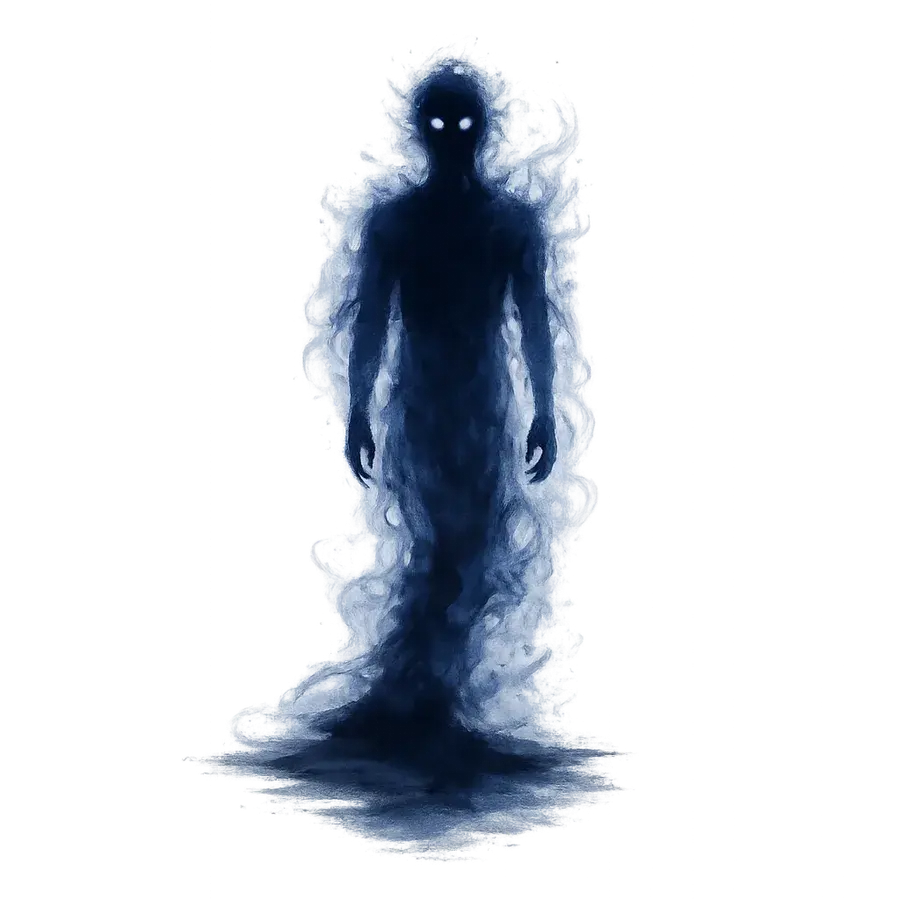
A dark humanoid figure, featureless, often seen at the edge of vision. The underlying experience is well documented; the name, the appearance and the shared details are substantially a product of the internet, and this page treats them separately.
Also called: shadow people, shadow figure, shadow man, dark figure
This is an archive of what people report. A consistent description across independent reports is evidence that an experience recurs. It is not evidence that anything external exists. How this archive is built
This entry is a case study in why the archive needs a contamination standard.
The experience (a dark, featureless humanoid shape, usually during the sleep-wake boundary, often peripheral) is real, common and long predates the term. It is the visual end of the same phenomenon covered in the Bedroom Presence entry.
The figure, as currently described, is not old. "Shadow people" as a named category with agreed characteristics emerged through late-1990s and 2000s internet forums, paranormal radio and the communities around them. A great deal of what is now reported consistently. The featurelessness, the red eyes some accounts specify, the hat variant, the behaviour of watching and fleeing: spread as a description before it spread as an experience.
That does not make the reports false. It makes them non-independent, and independence is the whole basis on which this archive draws conclusions.
Editorial assessment
Confidence: internet-influenced.
The underlying experience is well established and has a good physiological account. The specific figure, as reported today, cannot be treated as independently corroborated: the description was widely available before most current reporters had the experience, and priming effects on hallucinatory content are exactly what you would expect.
This is not a dismissal. It is the honest position, and it is more interesting than the alternative, because what this entry actually documents is a culturally assembled figure attaching itself to a physiological experience in real time, which is the same process Hufford described, happening now, where it can be watched.
For a report to strengthen this entry meaningfully it would need to come from someone with no prior exposure to the term. The report form asks.
Typical appearance
Humanoid, solid black, no discernible features, often described as darker than the surrounding darkness. Frequently peripheral: seen from the corner of the eye and gone on looking directly.
Some accounts specify red or glowing eyes. That detail correlates strongly with prior exposure to the online material and should be treated with particular caution.
Typical behaviour
Watches. Stands still. Moves quickly when observed directly. Passes through doorways. Rarely interacts and almost never speaks.
Where it appears
Bedrooms overwhelmingly, at the sleep-wake boundary. Also hallways and peripheral vision in low light while awake, which places some reports outside dreaming altogether.
Common encounter sequence
- Waking, or lying awake in low light.
- A dark shape noticed, usually peripherally.
- Fear disproportionate to a shape.
- The figure gone on direct inspection, or the episode ending with full waking.
How the dreamer feels
Dread and a sense of malevolent attention. Reports emphasise being noticed back.
Earliest traceable reports
Dark-figure sleep experiences are ancient and are documented within the sleep-paralysis traditions.
"Shadow people" as a named, characterised category traces to internet forums and paranormal broadcast media from roughly the late 1990s onward. The name and the standardised description are recent.
Geographic and community spread
Reports are now global and heavily concentrated in English-language online communities, which is what you would expect of a description spread by media rather than of an independently occurring phenomenon.
Similarities and differences
The Hat Man is treated as a distinct figure in the community material and has its own entry here, with the same caution applied.
Reports vary on whether the figure is peripheral or directly seen, and on whether the dreamer was paralysed. That second variable matters and is under-recorded: a shadow figure during sleep paralysis and a shadow figure in an ordinary dream are different claims.
Common associations
- Sleep paralysis, underneath.
- Peripheral vision artefacts, in the waking reports.
- Cultural assembly of a figure from a physiological experience.
- Priming, and its effect on hallucinated content.
Positive readings
Little. The useful outcome is understanding the mechanism.
Difficult readings
Sustained fear of the bedroom, which is reported and which affects sleep, creating exactly the sleep deprivation that makes further episodes more likely.
Psychological perspectives
Priming effects on hallucinatory content are well documented in general. Expectation shapes what an ambiguous percept resolves into, and a person who has read detailed accounts of shadow people has been supplied with a template.
Peripheral vision is poor at form and good at motion, which accounts for the "seen at the edge, gone when looked at" structure without requiring anything else.
Cultural and historical
The modern figure is a genuine piece of contemporary folklore and worth documenting as such, which is a different project from documenting a shared dream entity, and this page keeps the two apart.
What the sleep science says
Sleep-paralysis hallucination accounts for the sleep-boundary reports. Peripheral-vision characteristics account for many waking ones. Priming accounts for the consistency of the description.
No evidence supports an external entity, and no mechanism has been proposed that would.
Your own context
- Had you heard of shadow people before your first experience? The question this entry turns on.
- Could you move?
- Was it peripheral or directly seen?
- Were you asleep, waking, or awake?
If this recurs
Track against the sleep log rather than the dream journal. Sleep debt and irregular schedules are the reliable predictors.
Emotions often reported
- dread
- fear
- terror
- unease
Questions for reflection
These are for your journal, not for us. Nothing you write is shared.
- Had I heard of shadow people before this first happened?
- Could I move?
- Did I see it directly or from the corner of my eye?
- Was I asleep, half-awake, or fully awake?
Dream interpretation is subjective. Nothing here is a diagnosis, a prediction, or medical advice.
Sources and reviewed references
4 references. What these labels mean
- 1.Sleep Paralysis and the Structure of Waking-Nightmare HallucinationsPeer-reviewed research
J. Allan Cheyne (2003) · Dreaming
Cited for: The three-factor structure of sleep-paralysis hallucinations (intruder, incubus and vestibular-motor experiences) which accounts for the recurring "presence in the room" and "pressure on the chest" reports.
- 2.The Terror That Comes in the Night: An Experience-Centered Study of Supernatural Assault TraditionsAcademic book
David J. Hufford (1982) · University of Pennsylvania Press
Cited for: The central finding behind this entire archive: that the "old hag" experience shows a stable core description across cultures with no prior exposure to the tradition. That is, the experience generates the folklore rather than the other way round.
- 3.Sleep Paralysis: Night-mares, Nocebos, and the Mind-Body ConnectionAcademic book
Shelley Adler (2011) · Rutgers University Press
Cited for: How culturally specific interpretations attach to a physiologically consistent sleep experience, and what happens when they do.
- 4.Lifetime Prevalence Rates of Sleep Paralysis: A Systematic ReviewPeer-reviewed research
Brian Sharpless and Jacques Barber (2011) · Sleep Medicine Reviews
Cited for: Prevalence estimates for sleep paralysis across general, student and psychiatric populations.
Encounters
How the shadow person has actually turned up for other dreamers, in their own words. Add a drawing if you have one. A picture describes a figure in a way that the words on this page have not already shaped.
Beside the bed, close enough that I moved my arm away
Not in a doorway and not across the room: right beside me, at about waist height to somebody standing. No features at all, just an absence of the room where it was. It went when the heating clicked on, which is when most of mine go. I have attached what I drew. There is nothing to it, which is the accurate part. Every attempt to put a face on it was me inventing.
Twice in a hotel, never at home
Both on work trips, both in unfamiliar rooms, both after very short sleep. I mention the circumstances because I think they are the more interesting part of my account than the figure was.
Certain someone was there, never saw anything
I would not say I saw a figure. I would say I was completely certain somebody was standing on my left, and that certainty was much stronger than anything my eyes were doing. Reading this page afterwards, that seems to be its own category.
In the hallway, twice, months apart
Not in the bedroom, which seems to be unusual from what is written above. Standing in the hallway both times, seen through the open door, and both times I was properly awake and had been for a minute or two. That is what I cannot get past.
Specific encounters
The variants people report most often. Each is written from the accounts rather than composed from this page.
Related figures
- Dream creatureThe Hat ManA tall dark figure in a brimmed hat, reported during sleep paralysis. The most famous entry in modern dream-entity folklore, and one where the evidence for independence is weaker than its reputation suggests.Internet-influenced
- Dream creatureThe Bedroom PresenceThe sense that someone is standing in the room, usually in a doorway or beside the bed, reported without any visual detail. It is the most common component of sleep paralysis and one of the most frightening experiences people have.Sleep-paralysis associated
- PersonFaceless personFaces are one of the things dreaming struggles to hold steady, so a figure without a clear face is common and mechanically unremarkable. It becomes significant when the facelessness is the point, when the dreamer notices and reacts to it.
- Dream creatureThe Old HagThe best-evidenced entry in this archive, and the one that founded the method. A crushing presence during sleep paralysis, reported with a consistent core description across cultures that had no contact with each other.Widely reported
- Dream creatureThe Serpentine PresenceDistinct from an ordinary snake dream: an enormous serpentine form reported as aware, deliberate and of impossible scale. Uncommon, vividly remembered, and reported as awe more often than fear.Emerging pattern
- Dream creatureThe Black DogA famous folkloric figure with a very thin dream record. Included, and marked insufficient, as a worked example of an entry that does not meet this archive's standard.Insufficiently verified