The Nocturnal Bestiary
The Serpentine Presence
No reports collected on this site yet. See the assessment
- Ordinary dream
- Nightmare
- Sleep paralysis
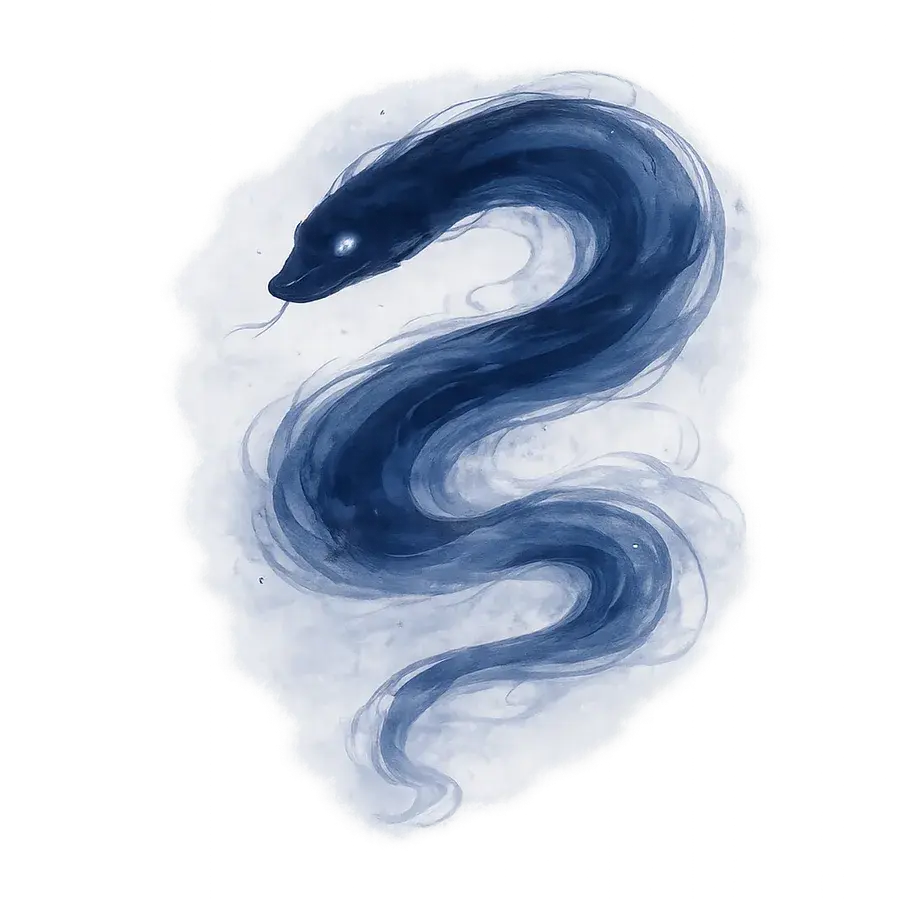
Distinct from an ordinary snake dream: an enormous serpentine form reported as aware, deliberate and of impossible scale. Uncommon, vividly remembered, and reported as awe more often than fear.
Also called: huge snake, serpent entity, coiling thing, the long one
This is an archive of what people report. A consistent description across independent reports is evidence that an experience recurs. It is not evidence that anything external exists. How this archive is built
This entry exists because a subset of snake reports do not read like the ordinary snake dreams covered under Symbols, and merging them loses something.
The distinguishing features are scale and intention. Not a snake in a room but a serpentine form of impossible size (filling a valley, under the ground, encircling something) and described as aware of the dreamer in a way an animal is not.
The emotional signature is also different. Ordinary snake dreams skew fearful. These skew towards awe, and dreamers frequently describe them as significant rather than frightening.
Editorial assessment
Confidence: emerging.
A small number of independent reports with an unusually consistent emotional signature and a distinctive structural feature, awareness combined with impossible scale.
The problem is contamination, and it is severe: giant serpents are among the most widespread mythological figures on earth, so almost every reporter has prior exposure. Under this archive's own standard, that is disqualifying for strong conclusions.
Kept at emerging because the emotional consistency (awe rather than fear, in reports of an animal that otherwise reliably produces fear) is a genuine anomaly worth documenting. That inversion is the interesting part, not the serpent.
Typical appearance
Enormous. Length emphasised over thickness. Scales sometimes described in detail, sometimes absent. Occasionally described as partly underground, partly submerged, or extending beyond what can be seen.
A recurring detail: the dreamer never sees all of it.
Typical behaviour
Moves slowly or not at all. Regards the dreamer. Does not attack. Several reports describe a sense of being permitted to be present.
Where it appears
Landscape rather than interior: valleys, water, sky, underground. Rarely domestic, which sharply distinguishes it from ordinary snake dreams.
Common encounter sequence
- Awareness of something very large.
- Gradual comprehension of scale.
- Recognition of being regarded.
- Awe rather than flight.
- The dream ending without resolution or threat.
How the dreamer feels
Awe, and frequently a sense of insignificance that dreamers describe as not unpleasant. Fear is present but rarely dominant.
Earliest traceable reports
Enormous serpent figures appear in a very large number of unconnected traditions: Nāga, Jörmungandr, Rainbow Serpent traditions, Mesoamerican feathered serpents, and many others.
That breadth is exactly why this entry is cautious. When a figure is present in nearly every mythology, cultural exposure is nearly impossible to rule out, and shared imagery is a poor guide to shared experience.
Geographic and community spread
Reports are thin and geographically scattered. Treat the spread claim as weak.
Similarities and differences
Underground versus aquatic versus sky placement varies and may distinguish sub-patterns.
Whether the dreamer is addressed varies, and where the serpent communicates, reports read closer to the dream-guide material in the Luminous Archive.
Common associations
- Scale beyond comprehension.
- Awareness without threat.
- Awe, inverting the usual snake response.
- Widespread mythology, and the contamination it causes.
Positive readings
Frequently reported as one of the most significant dreams the dreamer has had. Several describe lasting effects on mood or perspective, which places these alongside the impactful-dream material under Wonder.
Difficult readings
Where the scale is oppressive rather than awesome, reports read closer to ordinary threat dreams.
Psychological perspectives
Snakes are over-represented in dreams generally. Awe and impactful dreams are a documented category. Whether the combination is a distinct phenomenon or simply the tail of the ordinary snake distribution is not currently answerable.
Cultural and historical
The mythological breadth is documented and is treated here as a contamination risk rather than as corroboration: a distinction that most writing in this area does not make.
What the sleep science says
Snakes are over-represented in dream content. Nothing supports this specific figure as distinct.
Your own context
- How big, and could you see all of it?
- Did it know you were there?
- Was it awe or fear?
- What serpent traditions are you familiar with?
If this recurs
Rare. A recurring serpentine presence with consistent placement would be a strong report.
Emotions often reported
- awe
- wonder
- fear
- detachment
- peace
Questions for reflection
These are for your journal, not for us. Nothing you write is shared.
- How large was it? Could I see all of it?
- Did it know I was there?
- Was I frightened, or something else?
- What serpent stories do I already know?
Dream interpretation is subjective. Nothing here is a diagnosis, a prediction, or medical advice.
Sources and reviewed references
4 references. What these labels mean
- 1.The Content Analysis of DreamsAcademic book
Calvin Hall and Robert Van de Castle (1966) · Appleton-Century-Crofts
Cited for: The standard coding system for dream content, and the normative frequencies that later studies are compared against. The reason claims like "aggression is more common in dreams than friendliness" can be stated numerically at all.
- 2.Man and His SymbolsPsychology literature
Carl Jung and others (1964) · Aldus Books
Cited for: The amplification method, the compensatory function of dreams, and the archetypal reading of recurring figures such as the shadow.
- 3.The Scientific Study of Dreams: Neural Networks, Cognitive Development and Content AnalysisAcademic book
G. William Domhoff (2003) · American Psychological Association
Cited for: The continuity hypothesis (that dream content largely reflects waking concerns) and a sustained critique of symbolic dream interpretation as an evidential method.
- 4.The Reinterpretation of Dreams: An Evolutionary Hypothesis of the Function of DreamingPeer-reviewed research
Antti Revonsuo (2000) · Behavioral and Brain Sciences
Cited for: The threat-simulation hypothesis. That the over-representation of threatening content in dreams may be functional rather than incidental.
Encounters
How the serpentine presence has actually turned up for other dreamers, in their own words. Add a drawing if you have one. A picture describes a figure in a way that the words on this page have not already shaped.
Enormous, and completely uninterested in eating me
Big enough that I only ever saw a section of it. I kept waiting for the part where it was a threat and that part did not arrive. I have been frightened of snakes my entire waking life, which is what makes this one strange to me. The drawing only shows part of it because that is genuinely all I ever had. I could not tell you how long it was.
Underneath the whole landscape
Not in the room and not in front of me. Under everything, the way you would know a train was under a street. I never saw it at all. I only knew the shape of the thing the ground was lying on top of.
Moving very slowly, and I was not the point of it
That is the part that separates this from every snake dream I have had. A snake dream is about you. This was not about me in the slightest and I was not sure it had registered that I was there.
During paralysis, which I gather is unusual for this one
Almost everything on this page is ordinary dreaming and mine was not. I was pinned, and the thing was in the room, and it was enormous in a room that could not have held it. It did nothing. I would like to know why that combination is rare.
Specific encounters
The variants people report most often. Each is written from the accounts rather than composed from this page.
Related figures
- SymbolSnakeSnakes are among the most reported dream animals and the most contradictory. Across traditions they carry both threat and renewal, the bite and the shed skin, and which one is active in your dream is usually decided by the fear, not by the snake.
- EmotionWonderAwe-filled dreams are rare, disproportionately remembered, and reported by people of every belief and none. They are one of the more interesting things dreaming does.
- Dream protectorThe Dream GuideA figure who recurs across dreams and appears to know the dream is a dream. Reported almost entirely by people who practise lucid dreaming, which is both the interesting part and the problem.Emerging pattern
- Dream creatureThe Shadow PersonA dark humanoid figure, featureless, often seen at the edge of vision. The underlying experience is well documented; the name, the appearance and the shared details are substantially a product of the internet, and this page treats them separately.Internet-influenced
- Dream creatureThe WatcherA presence at the edge of a dream landscape (treeline, doorway, horizon) that watches and does not approach. Distinct from the bedroom presence in that it occurs inside dream narratives rather than at the sleep boundary.Emerging pattern
- Dream creatureThe Bedroom PresenceThe sense that someone is standing in the room, usually in a doorway or beside the bed, reported without any visual detail. It is the most common component of sleep paralysis and one of the most frightening experiences people have.Sleep-paralysis associated