The Nocturnal Bestiary
The Old Hag
No reports collected on this site yet. See the assessment
- Sleep paralysis
- Hypnopompic (waking up)
- Hypnagogic (falling asleep)
The best-evidenced entry in this archive, and the one that founded the method. A crushing presence during sleep paralysis, reported with a consistent core description across cultures that had no contact with each other.
Also called: old hag, night hag, hag attack, kanashibari, mara, the crushing weight
This is an archive of what people report. A consistent description across independent reports is evidence that an experience recurs. It is not evidence that anything external exists. How this archive is built
If this archive has a founding case, it is this one, and unusually, the argument was made properly forty years ago by a folklorist rather than by the internet.
David Hufford's The Terror That Comes in the Night (1982) documented the Newfoundland "Old Hag" tradition and found something that changed how these experiences are studied: the core description was consistent among people who had no prior knowledge of the tradition. Waking paralysed, a sensed presence, pressure on the chest, terror, inability to speak or move.
That finding runs the usual explanation backwards. The folklore does not create the experience. The experience creates the folklore, and it does so independently, over and over, wherever people sleep.
The physiological account is now well established: this is sleep paralysis, and its hallucinatory components have a described structure. That does not diminish the entry. It is what makes it the strongest one here.
Editorial assessment
Confidence: widely reported. This label rests on published research (Hufford, Cheyne, Sharpless and Barber, Adler) not on reports collected by this site, of which there are currently none.
The strong version of the claim is well supported: a consistent core experience, occurring independently of cultural transmission, with an identified physiological mechanism.
The supernatural version is not supported by anything. Sleep paralysis with hallucinated presence explains the reports completely, and the fact that it explains them across every culture that has ever named it is a stronger and more interesting finding than any external entity would be.
What remains genuinely open and worth documenting: why the hallucinated presence is so consistently experienced as malevolent, and why chest pressure specifically.
Typical appearance
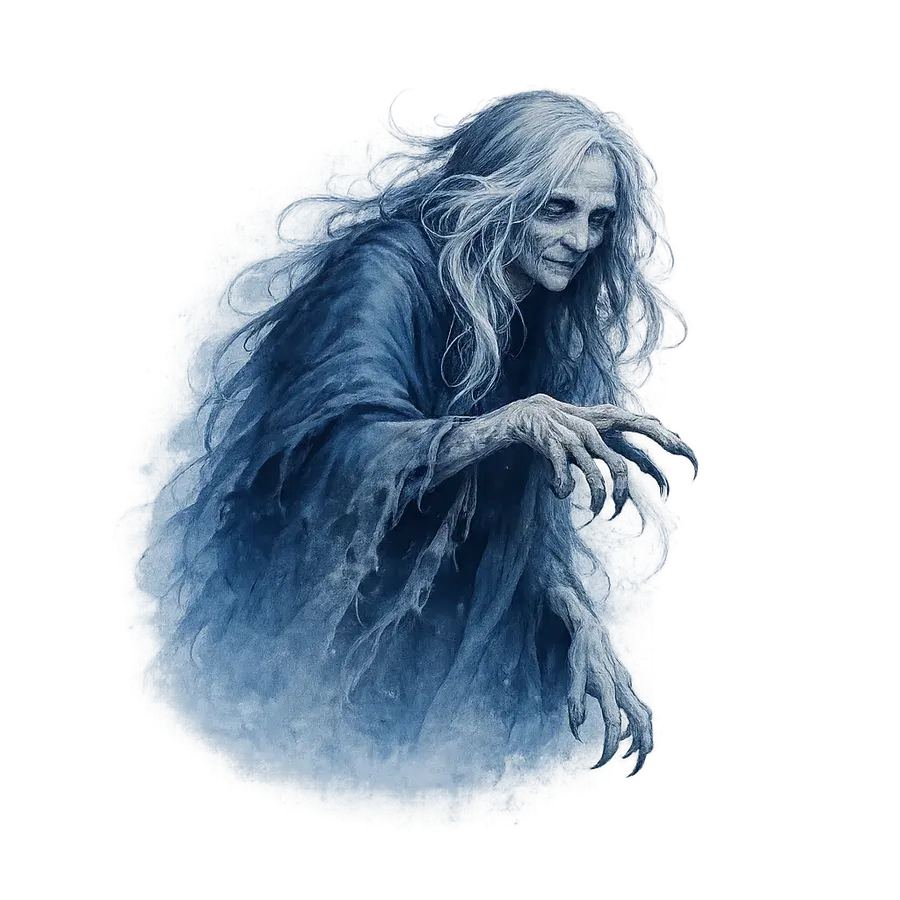
Reports vary far more on appearance than on sensation, which is itself the key observation.
Where a figure is described at all, it is most often an old woman, a hunched or crouching form, or an indistinct dark shape. Many reports describe no visual detail whatsoever, only a felt presence and a location, usually the chest or the bedside.
The visual variability against the sensory consistency is the pattern that matters. What people share is what they felt, not what they saw.
Typical behaviour
Sits, crouches, presses, holds down. Approaches slowly, or is simply already there. Very rarely speaks. Almost never does anything after the pressure. The experience ends rather than developing.
Where it appears
The dreamer's actual bedroom, in their actual sleeping position, with the room correctly reproduced. This is one of the defining features and the reason it is so often mistaken for a waking event: it is nearly one.
Common encounter sequence
Extremely consistent across cultures:
- Waking, or partial waking, usually on the back.
- Realising the body will not move.
- A sense of presence, typically before anything is seen.
- Pressure on the chest, difficulty breathing.
- Overwhelming terror; inability to speak or cry out.
- Resolution within seconds to a couple of minutes, ending on its own.
How the dreamer feels
Terror, at an intensity many people describe as the worst of their lives. Often accompanied by certainty of malevolence, with nothing in the scene to justify it.
Earliest traceable reports
The experience is documented across an extraordinary range of periods and places. The English word nightmare itself derives from the mare, a crushing night spirit. Comparable named traditions include kanashibari (Japan), the Old Hag (Newfoundland), and incubus/succubus traditions across Europe.
Hufford's fieldwork is the point at which the cross-cultural consistency was documented systematically rather than anecdotally.
Geographic and community spread
Global, with named traditions on every inhabited continent. Systematic review places lifetime prevalence of sleep paralysis at roughly 8% of the general population, substantially higher in student and psychiatric samples.
Similarities and differences
The interpretation varies enormously and tracks culture closely: a witch, a demon, a djinn, an alien, a dead relative, an intruder, a ghost. The experience varies remarkably little.
Shelley Adler's work on the same phenomenon in Hmong refugee communities documents what happens when the cultural interpretation is one of lethal supernatural attack, and it is the most sobering material in this area. Belief about the experience appears capable of affecting outcomes.
Common associations
- Sleep paralysis, which is what this is.
- The sensed presence, one of three described hallucination components.
- Chest pressure: the "incubus" component, likely related to the shallow, irregular breathing of REM.
- Cross-cultural consistency, the finding that matters.
Positive readings
Knowing what it is helps enormously and is well reported. People who learn that it is sleep paralysis, that it is common, and that it always ends on its own, report substantially less fear during subsequent episodes.
That is the single most useful thing this page does.
Difficult readings
The terror is genuine and can be extreme. Recurrent episodes are associated with sleep deprivation, irregular schedules, sleeping supine, and stress, all of which the sleep log tracks.
Frequent episodes are worth mentioning to a doctor. Not because they are dangerous, but because they usually indicate disrupted sleep that is worth fixing.
Psychological perspectives
The three-factor structure of sleep-paralysis hallucination (Cheyne) accounts for the reports: an intruder factor (sensed presence, fear), an incubus factor (pressure, breathing difficulty), and vestibular-motor factors (floating, falling, out-of-body sensations).
The presence is not seen because there is nothing to see. Threat-detection machinery signals someone is there without supplying a percept, and the mind supplies the rest from whatever it has, which is why the figure looks like a witch in one century and an alien in another.
Cultural and historical
The named traditions are the evidence here rather than decoration, and the archive treats them as data about a shared experience rather than as claims about shared entities.
What the sleep science says
Fully covered above. This is the best-evidenced entry in the Bestiary and the one where the science is most complete.
Your own context
- Could you move your real body?
- Were you in your actual room, in your actual position?
- Was there pressure on your chest?
- Had you heard of this before it first happened to you? This is the contamination check, and it is the most important question on the page.
If this recurs
Common. Track sleeping position, sleep duration and schedule regularity in the sleep log. The correlations are usually visible within a month and are actionable.
Emotions often reported
- terror
- dread
- helplessness
- fear
Questions for reflection
These are for your journal, not for us. Nothing you write is shared.
- Could I move my real body?
- Was I on my back?
- Was there pressure on my chest?
- Had I heard of this before it happened to me?
Dream interpretation is subjective. Nothing here is a diagnosis, a prediction, or medical advice.
Sources and reviewed references
4 references. What these labels mean
- 1.The Terror That Comes in the Night: An Experience-Centered Study of Supernatural Assault TraditionsAcademic book
David J. Hufford (1982) · University of Pennsylvania Press
Cited for: The central finding behind this entire archive: that the "old hag" experience shows a stable core description across cultures with no prior exposure to the tradition. That is, the experience generates the folklore rather than the other way round.
- 2.Sleep Paralysis and the Structure of Waking-Nightmare HallucinationsPeer-reviewed research
J. Allan Cheyne (2003) · Dreaming
Cited for: The three-factor structure of sleep-paralysis hallucinations (intruder, incubus and vestibular-motor experiences) which accounts for the recurring "presence in the room" and "pressure on the chest" reports.
- 3.Lifetime Prevalence Rates of Sleep Paralysis: A Systematic ReviewPeer-reviewed research
Brian Sharpless and Jacques Barber (2011) · Sleep Medicine Reviews
Cited for: Prevalence estimates for sleep paralysis across general, student and psychiatric populations.
- 4.Sleep Paralysis: Night-mares, Nocebos, and the Mind-Body ConnectionAcademic book
Shelley Adler (2011) · Rutgers University Press
Cited for: How culturally specific interpretations attach to a physiologically consistent sleep experience, and what happens when they do.
Encounters
How the old hag has actually turned up for other dreamers, in their own words. Add a drawing if you have one. A picture describes a figure in a way that the words on this page have not already shaped.
Old woman, close to the face, no sound
The only one of mine that had a face. Close enough that it filled most of what I could see, and completely silent. I had not heard the term "old hag" before it happened, and I found this page by searching for the description rather than the name. Drawing it helped, oddly. It is a much smaller thing on paper than it was in the room.
My grandmother had a word for this
Marek
She used a name for it that I will not write here because I have seen what happens when a name gets loose on the internet and comes back as evidence. What matters is that she described the same thing, in a village with no television, sixty years before I had it.
On the chest, and it had weight
Whatever was on me was heavy in a way I would not describe as a feeling. My ribs were doing work. It lasted long enough that I remember deciding to stop trying to move, and it ended when I stopped.
Once, and I have never wanted it again
I have chased lucid dreams for four years and gone looking for most things deliberately. This is the one experience I have had that I would not repeat on purpose. Nothing happened. It was just very close and very old and completely silent.
Specific encounters
The variants people report most often. Each is written from the accounts rather than composed from this page.
Related figures
- Dream creatureThe Bedroom PresenceThe sense that someone is standing in the room, usually in a doorway or beside the bed, reported without any visual detail. It is the most common component of sleep paralysis and one of the most frightening experiences people have.Sleep-paralysis associated
- ActionBeing unable to speak or moveBeing unable to move or make a sound is extremely common, and it sits on the boundary between an ordinary dream and sleep paralysis. Working out which one you had is the single most useful thing this page can help with.
- ActionBeing watchedThe sense of being watched is one of the most consistently reported dream experiences and one of the hardest to describe, because the watcher is usually never seen. In sleep paralysis it has a specific, well-documented physiological basis.
- Dream protectorThe One Who IntervenesA figure that appears at the worst point of a nightmare and stops it. Rarely described, rarely identified, and reported with unusual emotional force: the most structurally interesting entry in this archive.Repeated pattern
- Dream creatureThe Hat ManA tall dark figure in a brimmed hat, reported during sleep paralysis. The most famous entry in modern dream-entity folklore, and one where the evidence for independence is weaker than its reputation suggests.Internet-influenced
- Dream creatureThe Shadow PersonA dark humanoid figure, featureless, often seen at the edge of vision. The underlying experience is well documented; the name, the appearance and the shared details are substantially a product of the internet, and this page treats them separately.Internet-influenced