The Nocturnal Bestiary
The Faceless Pursuer
No reports collected on this site yet. See the assessment
- Nightmare
- Ordinary dream
The figure in the most common nightmare there is. Reported by enormous numbers of people, almost never seen clearly, and that is very likely the explanation rather than the mystery.
Also called: faceless chaser, thing chasing me, the pursuer, no-face
This is an archive of what people report. A consistent description across independent reports is evidence that an experience recurs. It is not evidence that anything external exists. How this archive is built
Being chased is the most reported dream theme in existence, and the pursuer is characteristically unseen or featureless. Enormous numbers of independent people describe this. On raw counts it is the most widely reported figure in this entire archive.
The reason its confidence label is "repeated" rather than "widely reported" is that the consistency has a strong and unglamorous explanation: dreaming does not reliably render faces, and a pursuer behind you is not being looked at.
So the shared description may be a shared limitation rather than a shared figure. Two mechanisms (unstable facial rendering, and the fact that you do not see what chases you) predict facelessness without anything else being needed.
That said, this entry is retained at "repeated" rather than downgraded, because the reports genuinely are independent and genuinely are consistent, and the archive should not confuse "explained" with "not real".
Editorial assessment
Confidence: repeated.
The reports are independent, ancient, cross-cultural and enormous in number. That part is not in doubt.
The consistency, though, is well explained without invoking a shared entity: dreams do not render faces reliably, and a pursuer is by definition behind you. Threat-simulation theory further predicts that chase scenarios should be over-represented for functional reasons.
The entry is kept at "repeated" rather than "widely reported" because "widely reported" in this archive is reserved for cases where the specific characteristics are independently corroborated. Here the specific characteristic is an absence, and an absence is a weak thing to corroborate.
What would be genuinely interesting: dreamers reporting a consistent, described, recurring personal pursuer with stable features. That is a different and much stronger claim, and the report form separates it out.
Typical appearance
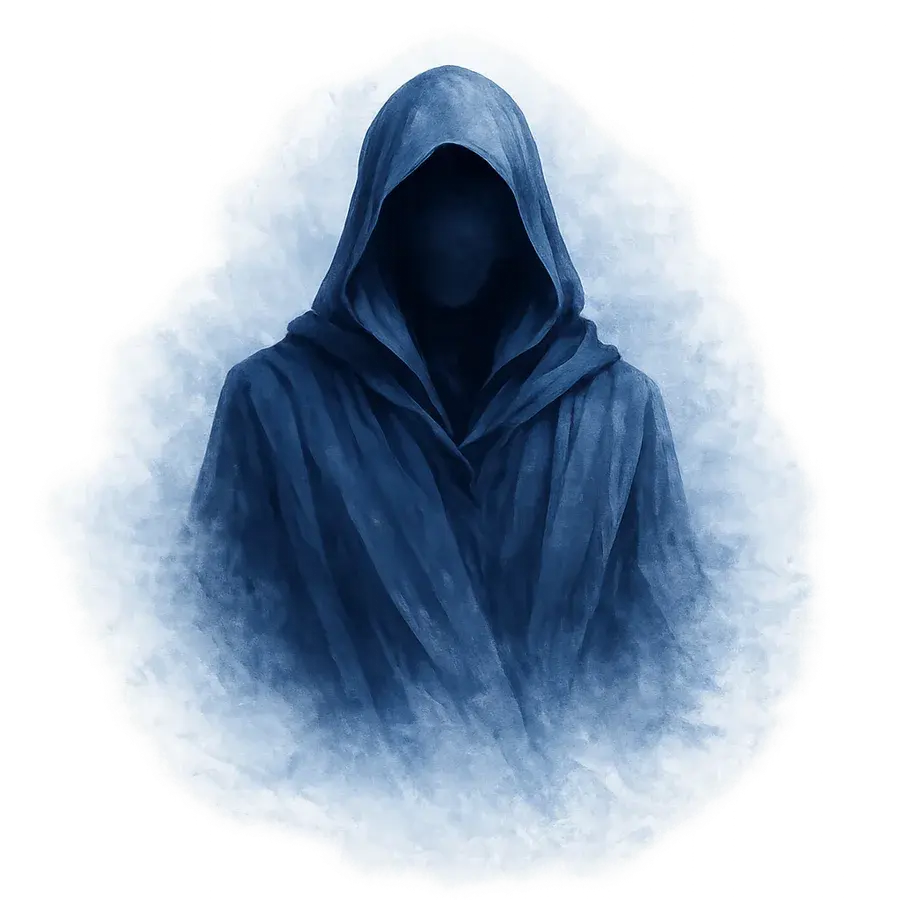
Usually none. Where described: a dark humanoid form, a blank or blurred face, a hood, or a figure never seen because the dreamer never turns.
A substantial minority of dreamers report knowing what it was without ever seeing it.
Typical behaviour
Pursues. Does not tire. Keeps pace regardless of the dreamer's speed. Very rarely catches the dreamer, and reports of what happens if it does are scarce, most dreams end first.
Where it appears
Everywhere. Streets, houses, corridors, woodland, open ground. The pursuit is portable in a way most dream content is not.
Common encounter sequence
- Awareness of pursuit, often before anything is seen.
- Flight, frequently impeded, slow motion, heavy legs.
- The pursuer maintaining distance regardless of effort.
- Waking, or the dream ending, before resolution.
How the dreamer feels
Terror and urgency. Notably, dreamers who are asked what would happen if it caught them usually cannot answer. The threat has no specified content.
Earliest traceable reports
Chase dreams appear in the earliest dream literature and are among the first dreams children report. This is not a modern figure and shows no sign of being culturally transmitted.
Geographic and community spread
Universal. Chase dreams appear at or near the top of typical-dream surveys in every population studied.
Similarities and differences
Some dreamers report a consistent personal pursuer across years, which is a more interesting claim than the general pattern and is what this entry most wants reports of.
Where the pursuer is described as an animal, or as a specific known person, the reports read quite differently and should be logged separately.
Common associations
- Threat simulation, the leading functional account.
- Unstable facial rendering, the mechanical account.
- Avoidance, the psychological reading.
- Absence as a description.
Positive readings
Turning to face it is the most reported positive resolution in chase dreams, and reports of doing so are consistent: the pursuit stops, or the pursuer is less than expected.
Imagery rehearsal therapy, rewriting the ending while awake, has real clinical evidence for recurrent nightmares, and this is the figure it is most often applied to.
Difficult readings
Recurrent chase nightmares are associated with waking stress and are one of the most common presentations in nightmare treatment.
Psychological perspectives
Threat-simulation theory (Revonsuo) treats chase dreams as the flagship case for a rehearsal function, supported by their early childhood appearance and cross-cultural consistency.
Cultural and historical
Wild Hunt and pursuing-spirit traditions exist widely, but the dream considerably predates and outnumbers them. Here the folklore looks like a response to the dream rather than a source of it, which is the same direction of causation Hufford identified for the Old Hag, and worth noting as a pattern.
What the sleep science says
Chase dreams top typical-dream surveys. Threatening content is over-represented in dreams. Facial and fine visual detail is unstable in dreaming. Imagery rehearsal therapy has meaningful evidence.
Your own context
- Did you ever see it?
- What would have happened if it caught you?
- Is it the same pursuer each time? The important question.
- Have you ever turned around?
If this recurs
The most commonly recurring nightmare there is. If it recurs and distresses, the nightmare-rescripting programme is built for it.
Emotions often reported
- terror
- fear
- urgency
- helplessness
- dread
Questions for reflection
These are for your journal, not for us. Nothing you write is shared.
- Did I ever see it?
- Is it the same one as last time?
- What would have happened if it caught me?
- Have I ever turned around?
Dream interpretation is subjective. Nothing here is a diagnosis, a prediction, or medical advice.
Sources and reviewed references
4 references. What these labels mean
- 1.The Typical Dreams of Canadian University StudentsPeer-reviewed research
Tore Nielsen and colleagues (2003) · Dreaming
Cited for: The cross-population consistency of "typical dream" themes (being chased, falling, teeth, flying, being unprepared for an exam) and their relative reported frequencies.
- 2.The Reinterpretation of Dreams: An Evolutionary Hypothesis of the Function of DreamingPeer-reviewed research
Antti Revonsuo (2000) · Behavioral and Brain Sciences
Cited for: The threat-simulation hypothesis. That the over-representation of threatening content in dreams may be functional rather than incidental.
- 3.Nightmares: A New Neurocognitive ModelPeer-reviewed research
Tore Nielsen and Ross Levin (2007) · Sleep Medicine Reviews
Cited for: A model of nightmare production combining affect load and affect distress, and the distinction between bad dreams and nightmares proper.
- 4.The Content Analysis of DreamsAcademic book
Calvin Hall and Robert Van de Castle (1966) · Appleton-Century-Crofts
Cited for: The standard coding system for dream content, and the normative frequencies that later studies are compared against. The reason claims like "aggression is more common in dreams than friendliness" can be stated numerically at all.
Encounters
How the faceless pursuer has actually turned up for other dreamers, in their own words. Add a drawing if you have one. A picture describes a figure in a way that the words on this page have not already shaped.
It never gained and it never dropped back
The distance was the horror, not the thing itself. Exactly the same gap for what felt like the whole dream, round the garages and out onto the road. I never turned round properly, so I cannot honestly tell you it had no face, only that I knew it had no face. The drawing is a guess for that reason. I have drawn the thing I was certain of rather than the thing I saw.
Turned round once
After about four years of this dream I turned round in it, which I had read you were supposed to do. There was nothing there. The dream did not end, it just carried on without the chase, and I woke up feeling completely flat rather than relieved.
It was the sound rather than anything I saw
I never turned round in mine either, so I have nothing visual to give you. What I have is the footsteps, which were exactly in time with mine. Not close behind and not far off. In time.
Chased through a building I had drawn
A real project of mine, and I knew the plan, and it did not help at all. Every route I took was one I had designed and it still came out wrong. Knowing the building made it worse rather than better, which I have thought about a lot since.
Specific encounters
The variants people report most often. Each is written from the accounts rather than composed from this page.
What happened
Related figures
- ActionBeing chasedBeing chased is the most reported dream theme in most surveys. What matters is almost never the pursuer. It is that the dreamer is going away from something, and what happens if they stop.
- PersonFaceless personFaces are one of the things dreaming struggles to hold steady, so a figure without a clear face is common and mechanically unremarkable. It becomes significant when the facelessness is the point, when the dreamer notices and reacts to it.
- EmotionFearFear is the most commonly reported dream emotion in most content analyses. A frightening dream is not unusual and is not by itself a sign of anything wrong.
- Dream creatureThe Bedroom PresenceThe sense that someone is standing in the room, usually in a doorway or beside the bed, reported without any visual detail. It is the most common component of sleep paralysis and one of the most frightening experiences people have.Sleep-paralysis associated
- Dream creatureThe Black DogA famous folkloric figure with a very thin dream record. Included, and marked insufficient, as a worked example of an entry that does not meet this archive's standard.Insufficiently verified
- Dream creatureThe DoubleEncountering yourself in a dream. Reported far less often than the folklore suggests, and the genuinely striking version, a double that acts independently, is rarer still.Emerging pattern