Dreaming about an abandoned building
Abandoned buildings combine two strong dream elements: an interior to explore and evidence that people have gone. Reports centre on what was left behind rather than on the building.
Also searched as: derelict building, ruins, empty building, abandoned house
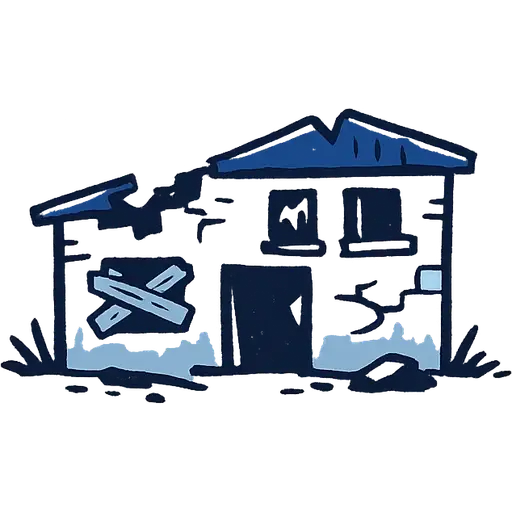
Abandoned buildings are a favourite dream setting and one where the reports are unusually detailed. Dreamers describe peeling paper, water damage, furniture still in place, and, most consistently, objects left behind.
The building is rarely threatening in itself. What generates the feeling is the evidence of departure: a table still laid, coats on hooks, a room someone clearly left in a hurry. The dream is about absence with traces.
Common associations
- Abandonment, of a place, a plan, or a version of a life.
- What remains after something ends.
- Decay and time.
- The unexplored, in the same family as the hidden-room material but darker.
- Trespass. Dreamers frequently report feeling they should not be there.
Positive readings
Exploration dreams in abandoned places are reported with real pleasure by some dreamers: curiosity rather than fear, and often a sense of privilege at seeing something private.
Finding something valuable or personal in a derelict building is a distinctive and warmly reported variant.
Difficult readings
The feeling of not being alone, which recurs constantly in these reports and almost never resolves.
Floors that are unsafe, or a building that becomes unstable, merging with the falling material.
Recognising the building as somewhere from your life is reported as much more distressing than exploring a stranger's ruin.
Psychological perspectives
If the house-as-self reading is applied, an abandoned building is an obvious and rather bleak image: a part of the self no longer occupied. That is offered as a reading, not a finding.
Continuity is worth checking: urban exploration content is extremely popular online and is exactly the kind of vivid visual material that gets incorporated into dreams.
Cultural and historical
Ruins as memento mori are a long-standing European artistic and literary tradition. Abandoned places as the dwelling of spirits appear very widely, generally on the logic that the departed leave something behind.
What the sleep science says
No specific research. Setting frequency data does not break out abandoned structures. Continuity and media exposure are the defensible explanations available.
Your own context
- What was left behind? The most informative detail.
- Did you recognise the building?
- Did you feel you should not be there?
- Were you looking for something?
If this recurs
Recurring derelict-building dreams are less common than recurring house dreams and are worth logging by building rather than by event: dreamers sometimes find they return to the same one.
Emotions often reported
- unease
- curiosity
- sadness
- fear
- wonder
- detachment
Specific abandoned building dreams
Each of these is written separately, not generated from this page.
What state it was in
Questions for reflection
These are for your journal, not for us. Nothing you write is shared.
- What had been left behind?
- Did I know the building?
- Did I feel I was trespassing?
- Was I alone? How sure was I?
Dream interpretation is subjective. Nothing here is a diagnosis, a prediction, or medical advice.
Sources and reviewed references
3 references. What these labels mean
- 1.The Scientific Study of Dreams: Neural Networks, Cognitive Development and Content AnalysisAcademic book
G. William Domhoff (2003) · American Psychological Association
Cited for: The continuity hypothesis (that dream content largely reflects waking concerns) and a sustained critique of symbolic dream interpretation as an evidential method.
- 2.The Content Analysis of DreamsAcademic book
Calvin Hall and Robert Van de Castle (1966) · Appleton-Century-Crofts
Cited for: The standard coding system for dream content, and the normative frequencies that later studies are compared against. The reason claims like "aggression is more common in dreams than friendliness" can be stated numerically at all.
- 3.Man and His SymbolsPsychology literature
Carl Jung and others (1964) · Aldus Books
Cited for: The amplification method, the compensatory function of dreams, and the archetypal reading of recurring figures such as the shadow.
Dreamers’ accounts
How dreams of abandoned building have gone for other people, in their own words. Nothing here is an interpretation of anyone else's dream. It is a record of what happened and what it was like.
Nothing here yet. Be the first to say how this has gone for you.
Related records
- PlaceChildhood homeThe most reported dream setting there is. It usually appears altered (extra rooms, wrong layout, doors that were not there) and the alterations are more informative than the house.
- ActionBeing watchedThe sense of being watched is one of the most consistently reported dream experiences and one of the hardest to describe, because the watcher is usually never seen. In sleep paralysis it has a specific, well-documented physiological basis.
- ActionSearchingSearching dreams almost never resolve. That is not a symbol (dreams are structurally poor at completing a search) but what is being looked for, and for whom, is worth recording.
- PlaceBeachThe beach is a boundary, and dream reports treat it as one: it is where land meets water, and most beach dreams are about what is happening at that edge rather than about the beach itself.
- PlaceChurchPlaces of worship in dreams are reported very differently depending on the dreamer's own relationship to religion, which makes this one of the entries where a generic reading is most useless.
- PlaceEndless corridorCorridors that do not end are one of the most consistently described dream architectures. They are transitional space with the destination removed, and they are reported as exhausting rather than frightening.