The Nocturnal Bestiary
The Black Dog
No reports collected on this site yet. See the assessment
- Ordinary dream
- Nightmare
A famous folkloric figure with a very thin dream record. Included, and marked insufficient, as a worked example of an entry that does not meet this archive's standard.
Also called: black dog, black shuck, the hound, large black dog
This is an archive of what people report. A consistent description across independent reports is evidence that an experience recurs. It is not evidence that anything external exists. How this archive is built
This entry is here to demonstrate the standard rather than to satisfy it, and that is stated up front.
The black dog is one of the most documented figures in British folklore: Black Shuck, the Barghest, Padfoot and many local variants, generally as an omen encountered on roads at night. The folkloric record is substantial and well studied.
The dream record is not. Reports of black dogs in dreams exist, but they are not notably more frequent than reports of other animals, they do not share a distinctive cluster of characteristics, and there is no evidence that the folkloric figure originates in or is sustained by dream experience.
Under this archive's inclusion standard: several independent reports sharing a meaningful cluster of characteristics, with a demonstrable connection to dreams. The black dog does not currently qualify.
Editorial assessment
Confidence: insufficiently verified.
This entry fails the archive's own inclusion standard and is published anyway, deliberately.
Plan §12 is explicit: "A general monster from a history book does not qualify simply because it is frightening. It must have a demonstrable connection to dreams or sleep experiences." The black dog is the clearest available test of whether this site actually applies that rule to a figure people would enjoy reading about.
It does. The folklore is real and interesting. The dream evidence is thin, inconsistent and does not cluster. Until reports arrive showing a genuine shared pattern (consistent behaviour, setting, or encounter sequence) this entry stays here as a documented negative.
An archive that only publishes its successes cannot be audited. This is the entry that makes the labels mean something.
Typical appearance
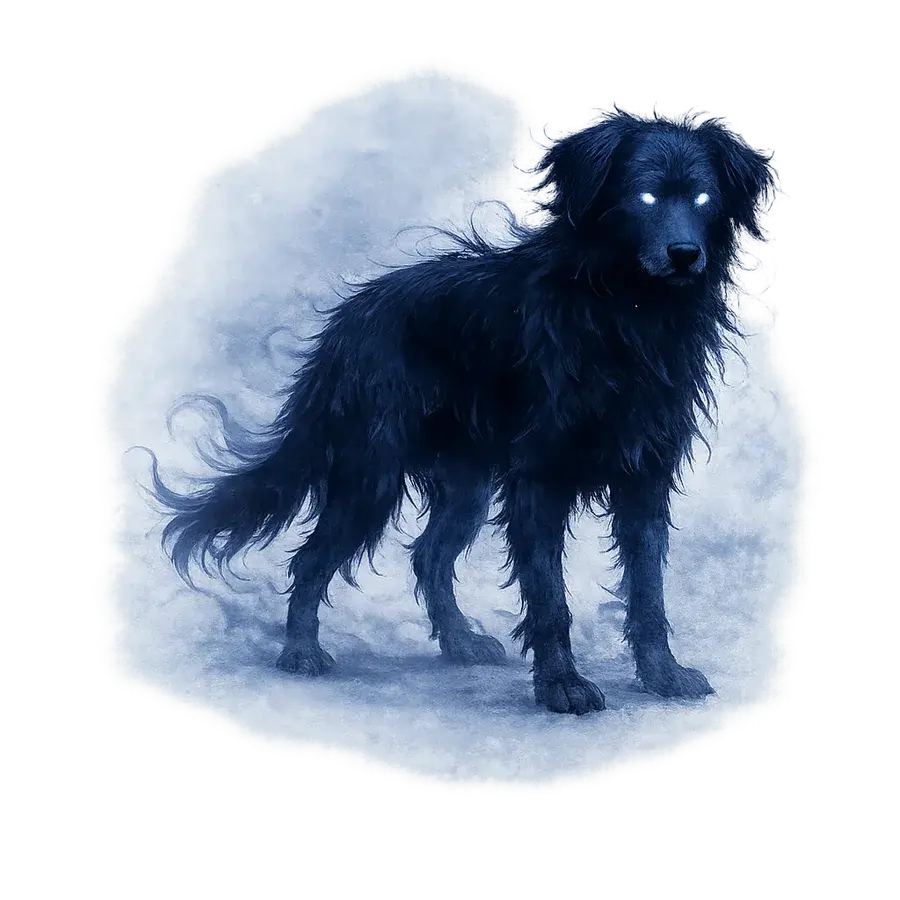
Large, black, dog-shaped. Beyond that, reports diverge substantially: size ranges from ordinary to enormous, eyes are sometimes described as luminous and usually not, and there is no consistent additional feature.
Typical behaviour
Highly variable. Watches, accompanies, blocks a path, follows, or is simply present. Some reports describe it as protective, some as ominous, most as ambiguous.
That variability is precisely the problem: a figure with no consistent behaviour is not a pattern.
Where it appears
Roads, paths, open ground, occasionally domestic. No consistent setting emerges.
Common encounter sequence
No consistent encounter sequence is discernible from available reports. This is itself a finding and it is why the entry is marked insufficient.
How the dreamer feels
Ranges from dread to comfort. Several reporters describe the dog as reassuring, which would place those accounts in the Luminous Archive rather than here.
Earliest traceable reports
The folkloric record is extensive and well documented, particularly in East Anglia and northern England, with the Black Shuck accounts dating back centuries.
Whether any of that tradition derives from dream or sleep experience is unestablished, and the burden is on the claim rather than against it.
Geographic and community spread
The folklore is regionally concentrated. The dream reports are scattered and do not follow the folklore's geography, which, if anything, argues against a connection.
Similarities and differences
Too variable to characterise usefully, which is the point.
Common associations
- British folklore, substantially.
- Dream reports, insubstantially.
- The inclusion standard, demonstrated.
Positive readings
Reports of a protective or companionable black dog exist and are collected. Those belong with the guardian-animal material, and several have been cross-filed there.
Difficult readings
Where ominous, reports read as ordinary animal-threat dreams without distinguishing features.
Psychological perspectives
Dogs are among the more commonly reported dream animals, which is unsurprising given how many people live with them. Nothing in the reports requires an explanation beyond that.
The "black dog" as a metaphor for depression is a separate modern usage and is not evidence of anything about dreams, though it plausibly colours how some dreamers describe these dreams.
Cultural and historical
Well documented and genuinely interesting. Recorded as folklore, and explicitly not as dream evidence.
What the sleep science says
No relevant research. Dogs are common dream animals; that is the whole of it.
Your own context
- Was it a specific dog you know? Often yes.
- Did it do anything consistent?
- Did you know the Black Shuck stories?
- Was it threatening or companionable?
If this recurs
A recurring black dog with consistent behaviour would be exactly the report that could move this entry. That is an open invitation.
Emotions often reported
- unease
- dread
- safety
- confusion
Questions for reflection
These are for your journal, not for us. Nothing you write is shared.
- Was it a dog I actually know?
- Did it do anything specific?
- Had I heard the Black Shuck stories before?
- Did it feel threatening, or with me?
Dream interpretation is subjective. Nothing here is a diagnosis, a prediction, or medical advice.
Sources and reviewed references
3 references. What these labels mean
- 1.The Terror That Comes in the Night: An Experience-Centered Study of Supernatural Assault TraditionsAcademic book
David J. Hufford (1982) · University of Pennsylvania Press
Cited for: The central finding behind this entire archive: that the "old hag" experience shows a stable core description across cultures with no prior exposure to the tradition. That is, the experience generates the folklore rather than the other way round.
- 2.The Content Analysis of DreamsAcademic book
Calvin Hall and Robert Van de Castle (1966) · Appleton-Century-Crofts
Cited for: The standard coding system for dream content, and the normative frequencies that later studies are compared against. The reason claims like "aggression is more common in dreams than friendliness" can be stated numerically at all.
- 3.The Scientific Study of Dreams: Neural Networks, Cognitive Development and Content AnalysisAcademic book
G. William Domhoff (2003) · American Psychological Association
Cited for: The continuity hypothesis (that dream content largely reflects waking concerns) and a sustained critique of symbolic dream interpretation as an evidential method.
Encounters
How the black dog has actually turned up for other dreamers, in their own words. Add a drawing if you have one. A picture describes a figure in a way that the words on this page have not already shaped.
It stood between me and whatever was behind me
Came out from between two parked cars and stopped facing past me, and the chase simply stopped being a chase. I woke up calm. In every version of that dream before this one I woke up with my heart going. I have drawn it side-on and facing away, which is how it was the whole time. It never once looked at me.
Marek
Worth saying that in the folklore I grew up with this animal is usually the omen rather than the guard. The protective version exists too, particularly in the Welsh material, but they are not the same story. Whichever one you have heard first tends to be the one the dream hands you.
Sat outside the door and did not come in
Whole dream, sat on the step, facing out. I kept expecting it to be about the dog and it never was. It was about the door being covered while I got on with something else in the house.
Walked with me and did not look at me
The length of a whole dream, at my left, never once turning its head. Nothing happened and nothing was threatening. I would not call it a protector because there was nothing to protect me from.
I was not frightened, which surprised me afterwards
I am frightened of large dogs awake. This was an enormous black thing about the size of a pony and my reaction inside the dream was roughly the reaction you would have to a parked car. That mismatch is the interesting part to me, not the animal.
Specific encounters
The variants people report most often. Each is written from the accounts rather than composed from this page.
Related figures
- Dream protectorThe Guardian AnimalAn animal that positions itself between the dreamer and a threat. Dogs dominate the reports, and unlike most figures in this archive the guardian animal is usually described in detail.Repeated pattern
- Dream protectorThe Companion AnimalA pet: very often one that has died, appearing calm, well and present. Extremely commonly reported, consistently comforting, and one of the most under-acknowledged forms of grief there is.Widely reported
- Dream creatureThe Bedroom PresenceThe sense that someone is standing in the room, usually in a doorway or beside the bed, reported without any visual detail. It is the most common component of sleep paralysis and one of the most frightening experiences people have.Sleep-paralysis associated
- Dream creatureThe DoubleEncountering yourself in a dream. Reported far less often than the folklore suggests, and the genuinely striking version, a double that acts independently, is rarer still.Emerging pattern
- Dream creatureThe Faceless PursuerThe figure in the most common nightmare there is. Reported by enormous numbers of people, almost never seen clearly, and that is very likely the explanation rather than the mystery.Repeated pattern
- Dream creatureThe Hat ManA tall dark figure in a brimmed hat, reported during sleep paralysis. The most famous entry in modern dream-entity folklore, and one where the evidence for independence is weaker than its reputation suggests.Internet-influenced