The Nocturnal Bestiary
The Double
No reports collected on this site yet. See the assessment
- Ordinary dream
- Nightmare
- Lucid dream
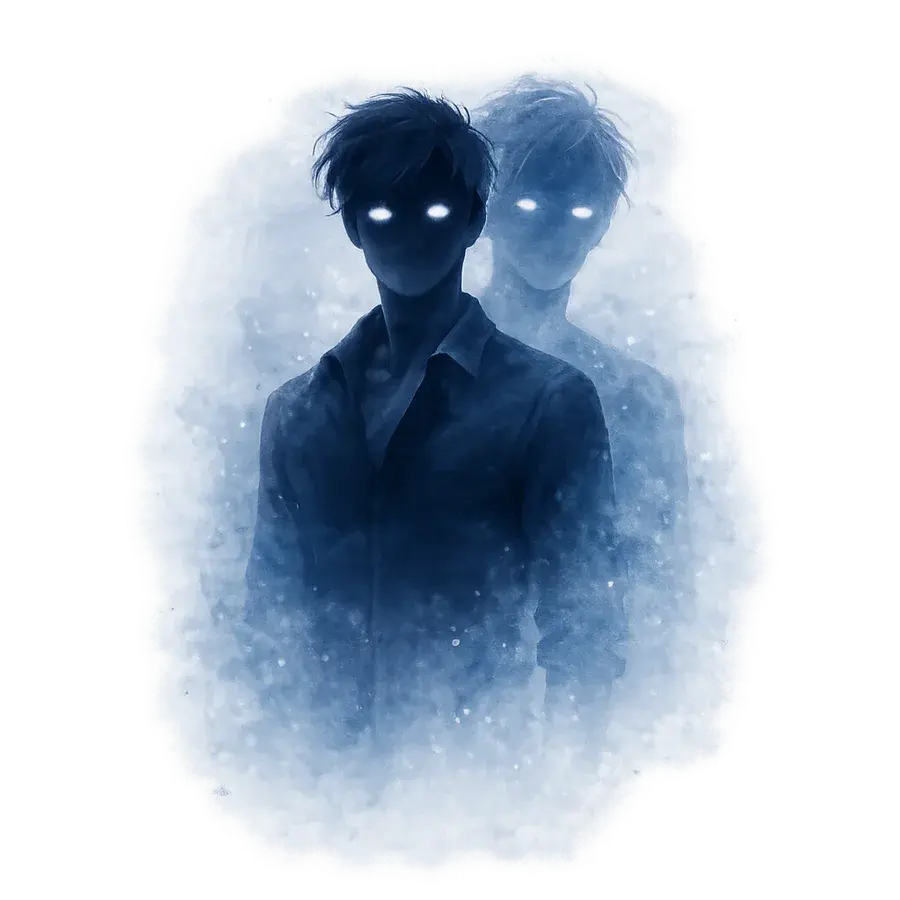
Encountering yourself in a dream. Reported far less often than the folklore suggests, and the genuinely striking version, a double that acts independently, is rarer still.
Also called: doppelganger, seeing myself, my double, the other me
This is an archive of what people report. A consistent description across independent reports is evidence that an experience recurs. It is not evidence that anything external exists. How this archive is built
The doppelgänger has an enormous literary and folkloric presence and a much smaller dream presence, which is worth stating first because it inverts the usual assumption.
Most reports filed under "doppelgänger" are actually mirror dreams (a reflection that is wrong) and those belong on the Mirror page. The genuine version, where the dreamer encounters a separate self who acts independently, is uncommon.
Where it does occur it is reported with unusual intensity and is remembered for years. It is also one of the few dream experiences that reliably provokes lucidity.
Editorial assessment
Confidence: emerging.
Genuine independent reports exist and are consistent in their emotional signature. The numbers are small, and the literary and folkloric tradition is strong enough that contamination is a real concern for anyone who has encountered it.
The most defensible reading is that this is a dream-mechanical event rather than an encounter: dream characters are constructed from the dreamer's own material, and a dream that constructs the dreamer is not doing anything it does not do constantly. It is just visible when it does.
Retained at emerging rather than downgraded because the age-variant reports are distinctive enough to be worth collecting.
Typical appearance
The dreamer, usually accurately. Sometimes at a different age. Sometimes subtly wrong in a way the dreamer struggles to specify.
Typical behaviour
Acts independently. Ignores the dreamer, or watches them, or continues with a life the dreamer is not part of. Rarely hostile. The distress is conceptual rather than physical.
A recurring reported detail: the double is unbothered.
Where it appears
Ordinary dream settings, frequently domestic. The mundanity is part of what unsettles people.
Common encounter sequence
- An ordinary dream.
- The dreamer sees themselves.
- A period of watching, often without either acknowledging the other.
- Strong emotional response; sometimes lucidity.
How the dreamer feels
Not usually fear. Reports emphasise displacement, wrongness, and occasionally a specific loneliness. Some describe curiosity.
Earliest traceable reports
The doppelgänger as a death omen is a well-documented European folk and literary tradition, with a substantial nineteenth-century literary presence.
Its dream footprint is much smaller and much more recent in the record, and the literary version almost certainly shapes how people describe the dream version.
Geographic and community spread
Reports are wide but thin. Self-encounter appears in dream literature across cultures, generally rarely.
Similarities and differences
Age differences are the most interesting variant (the double as a child, or as an old person) and those reports are frequently described as moving rather than disturbing.
The double being better off, which is reported alongside periods of regret about a decision.
Common associations
- Self-encounter.
- The shadow, in the Jungian reading.
- Dream-character construction made visible.
- Regret, in the better-off-double variant.
Positive readings
Encounters with a younger or older self are frequently reported as tender and significant, and some dreamers describe them as among their most valuable dreams.
Strongly associated with lucidity. The impossibility is hard to ignore.
Difficult readings
Displacement and a specific loneliness. Where the double is indifferent, reports are noticeably more distressing than where it is hostile.
Psychological perspectives
Jung's shadow material is the obvious framework and fits the hostile or indifferent variants reasonably.
More mechanically: dreams construct all characters from the dreamer's own material, and the self is the most available template of all. A dream double is not an anomaly; it is the ordinary process using the nearest model.
Cultural and historical
The death-omen tradition is well documented, largely European, and largely literary. It is recorded here and given no predictive weight.
What the sleep science says
No specific research. Dream characters are composites drawn from the dreamer's own memory, which accounts for the phenomenon without difficulty.
Your own context
- Did it act independently, or was it a reflection? This decides which page you want.
- What age was it?
- Did it acknowledge you?
- How did you feel, frightened, or something else?
If this recurs
Rare as recurring. Any recurring double with consistent characteristics would be a notable report.
Emotions often reported
- unease
- wonder
- sadness
- detachment
- confusion
Questions for reflection
These are for your journal, not for us. Nothing you write is shared.
- Did it act on its own, or was it a reflection?
- What age was it?
- Did it notice me?
- What did I feel: fear, or something else?
Dream interpretation is subjective. Nothing here is a diagnosis, a prediction, or medical advice.
Sources and reviewed references
3 references. What these labels mean
- 1.Man and His SymbolsPsychology literature
Carl Jung and others (1964) · Aldus Books
Cited for: The amplification method, the compensatory function of dreams, and the archetypal reading of recurring figures such as the shadow.
- 2.The Scientific Study of Dreams: Neural Networks, Cognitive Development and Content AnalysisAcademic book
G. William Domhoff (2003) · American Psychological Association
Cited for: The continuity hypothesis (that dream content largely reflects waking concerns) and a sustained critique of symbolic dream interpretation as an evidential method.
- 3.The Content Analysis of DreamsAcademic book
Calvin Hall and Robert Van de Castle (1966) · Appleton-Century-Crofts
Cited for: The standard coding system for dream content, and the normative frequencies that later studies are compared against. The reason claims like "aggression is more common in dreams than friendliness" can be stated numerically at all.
Encounters
How the double has actually turned up for other dreamers, in their own words. Add a drawing if you have one. A picture describes a figure in a way that the words on this page have not already shaped.
Myself, across a room, not interested in me
In a lucid one, so I had the presence of mind to look properly. It was doing something else and did not acknowledge me at all. I was much more unsettled by being ignored than I would have been by being looked at. Drawing attached. Being lucid meant I actually studied it, so this is the most reliable picture I have ever made of a dream.
It was wearing what I had worn that day
Same jumper, same everything, standing at the sink. It did not turn round and I did not go closer. When I woke up the jumper was over the chair where I had left it and I did not want to put it on.
In the mirror, half a second behind
The reflection did what I did but late. Not dramatically. The sort of late you would notice on a video call. I have never had it again and I still think about it.
Not a double exactly about ten years older
Same face, older. She was doing something at a table and was not remotely surprised to see me. I would not call it frightening. I would call it the single strangest thing my brain has ever produced.
Specific encounters
The variants people report most often. Each is written from the accounts rather than composed from this page.
What happened
What state it was in
Related figures
- SymbolMirrorMirrors in dreams are almost never about vanity. Dreamers overwhelmingly report the reflection being wrong (delayed, aged, a stranger, or absent) and it is the wrongness, not the mirror, that carries the meaning.
- PersonFaceless personFaces are one of the things dreaming struggles to hold steady, so a figure without a clear face is common and mechanically unremarkable. It becomes significant when the facelessness is the point, when the dreamer notices and reacts to it.
- Dream creatureThe Bedroom PresenceThe sense that someone is standing in the room, usually in a doorway or beside the bed, reported without any visual detail. It is the most common component of sleep paralysis and one of the most frightening experiences people have.Sleep-paralysis associated
- Dream creatureThe Black DogA famous folkloric figure with a very thin dream record. Included, and marked insufficient, as a worked example of an entry that does not meet this archive's standard.Insufficiently verified
- Dream creatureThe Faceless PursuerThe figure in the most common nightmare there is. Reported by enormous numbers of people, almost never seen clearly, and that is very likely the explanation rather than the mystery.Repeated pattern
- Dream creatureThe Hat ManA tall dark figure in a brimmed hat, reported during sleep paralysis. The most famous entry in modern dream-entity folklore, and one where the evidence for independence is weaker than its reputation suggests.Internet-influenced